
The case for Frontier Intelligence in Africa
History often gives hints to what the future may hold. The 16th century saw the first example of a paradigm shift in science, with the Copernican revolution changing our perspective of our place in the universe. A couple of hundred years later, a very different example of The Age of Reason reflected a move toward free rational inquiry. While these ideas were not new, it was their accessible reframing that changed the world. The pace of these leaps in progress have accelerated. With the Space Age we have broken the bounds of our terrestrial centricity, providing an orbital vantage point that no longer sees borders. The Information Age, powered by the humble transistor, has fundamentally changed the way we work, live, communicate, and love. By these definitions, we are now experiencing another reframing. The advances in compute capability, deep learning and artificial intelligence is opening a door to a new epoch of human experience: the Intelligence Age.
The FDL Foundations Big Think was an interdisciplinary workshop bringing together AI researchers, scientists, and African partner organisations to unlock the potential of foundation models and help shape the challenge set for the FDL Foundations programme.
FDL Foundations (Africa), delivered in partnership with SARAO, SANSA, DARA, the University of Cape Town, Stellenbosch University, Trillium Technologies and commercial AI partners such as Google Cloud and NVIDIA, brought together over 100 AI researchers, domain scientists, and partners for a hybrid two-day interdisciplinary workshop.
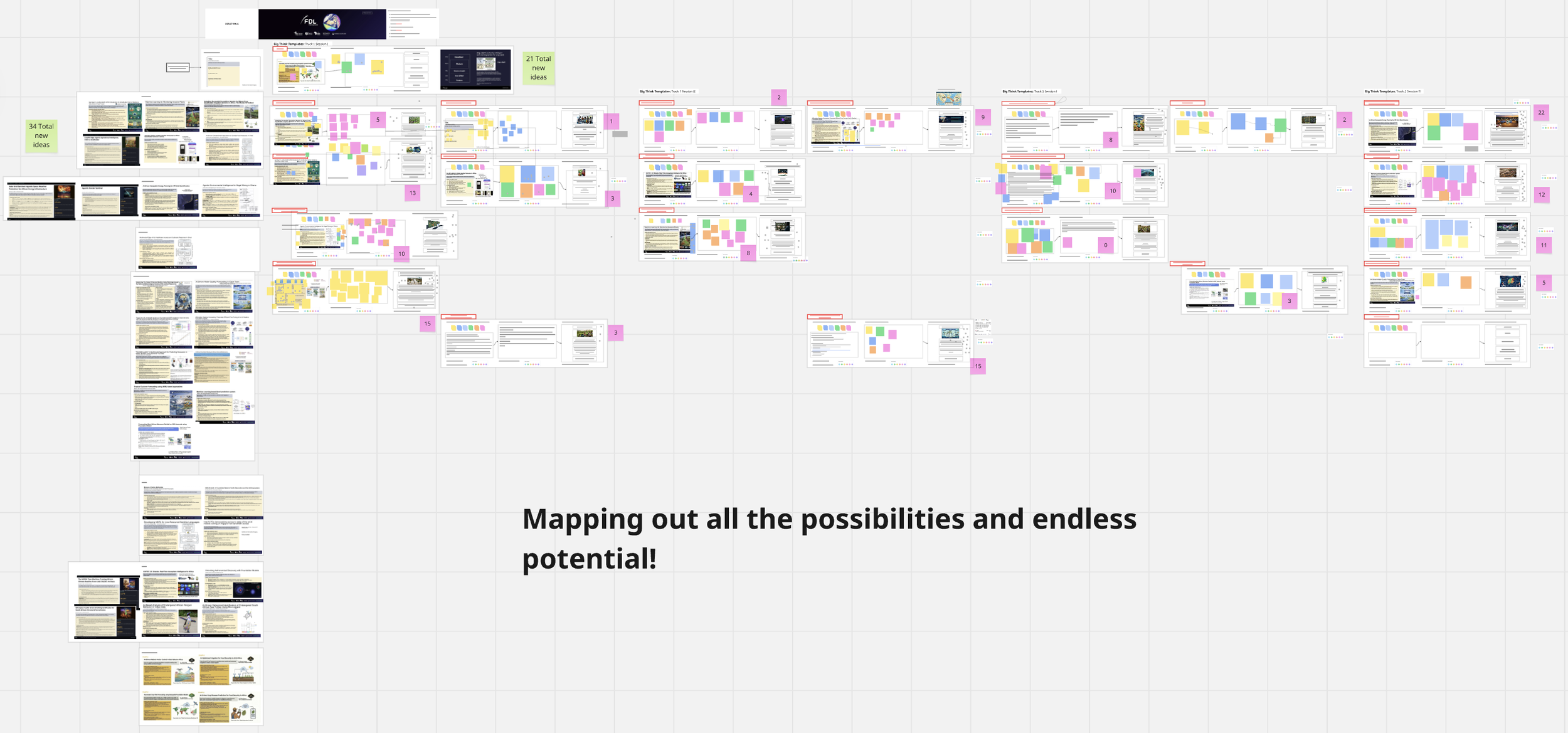
Over the course of the workshop, over 50 ideas evolved into one-page concept notes, which will form the basis of the challenge set for the FDL Foundations research sprint. At the heart of this vision is the catalyst of geospatial foundation models, enabling accessible frontier capabilities to be rapidly developed and deployed.
See Geospatial Studio: https://ibm-geospatial.vercel.app/
Historical epochs aren’t demarcated by a single technological invention, they are defined by the profound infrastructural and epistemological shifts those inventions precipitate. In 2026, public discourse remains distracted by the novelty of the latest agents passing a Turing test. However, focusing solely on these anthropocentric applications obscures a much more profound shift. The new era emerging is defined by the active integration of deep learning with pervasive sensor networks, increasing autonomy, and distributed computing to create a computational fabric that stretches around the Earth.
For the benefits of this potential to truly envelop the globe, it cannot be structurally centralised but rather deployed wherever needed, erasing traditional geographical bottlenecks. This is the foundational rationale for why we are actively supporting advanced applied AI in Africa, for Africa as part of FDL Foundations.
As has been famously observed, “Technology is neither good nor bad; nor is it neutral.” The unchecked deployment of AI introduces severe epistemological risks. In a commercial setting, there are structural incentives to produce fluent outputs which can fatally mask statistical fragility and hallucination. For AI to be scientifically valid in high-stakes scenarios, such as flood evacuation routing or agricultural yield prediction, applied AI solutions such as foundation models must trade fluency for epistemic humility. Through initiatives like FDL’s SHRUG-FM, architectural mechanisms may be included that systematically process real-world uncertainty. A model must possess the mathematical capacity to explicitly state when it lacks the local data to make a reliable determination, rather than hallucinating an answer.
Another profound stressor is the macroeconomic trajectory of the AI industry. The dominant paradigm overwhelmingly favors monolithic artificial general intelligence models containing quadrillions of parameters. Training and operating these massive architectures requires staggering energy resources and immense capital expenditure, centralising foundational compute within a handful of technology companies and even fewer countries.
For emerging economies, delegating the processing of critical environmental, agricultural, and socioeconomic data to these centralised entities is strategically untenable. It is a profound loss of intellectual sovereignty. When a nation relies entirely on external infrastructure for basic predictive capabilities, it implicitly accepts the embedded cultural biases, operational priorities, and proprietary constraints of a distant provider.
Mitigating these risks requires a deliberate structural pivot toward sovereign, hybrid computational ecosystems. Rather than defaulting to centralised nodes, FDL Foundations champions the cultivation of localised compute infrastructure. A responsible scientific strategy involves developing moderately sized, highly optimised foundation models. Fine-tuned on high-quality, locally relevant African data, these smaller models routinely match or outperform massive general models on specialised scientific tasks at a fraction of the energy cost, making localised compute financially and ecologically viable.
This decentralised architecture enables a sophisticated "mixture of experts" approach. Locally developed models handle local inference, ensuring the processing of sensitive regional data remains securely within national borders. Massive, energy-intensive offshore models are relegated to a supplementary role, utilised primarily for sanity-checking complex global anomalies or providing baseline planetary context.
Maintaining localised compute ultimately preserves scientific independence. By retaining control over their algorithms and proprietary datasets, Africa can cultivate unique, highly specialised AI capabilities , such as advanced localised agriculture, climate resilience modelling, or specific epidemiological tracking, which can then be exported and enrich insights globally.
Every historical epoch follows a trajectory from technological innovation to profound economic and cultural shifts, which is accelerated through accessibility. The current manifestation of this emerging epoch is not an inevitability that must be passively accepted.
When this networked intelligence equitably uplifts the wellbeing and scientific agency of all humankind, and only then, will we be able to say that we are truly in the Intelligence Age.
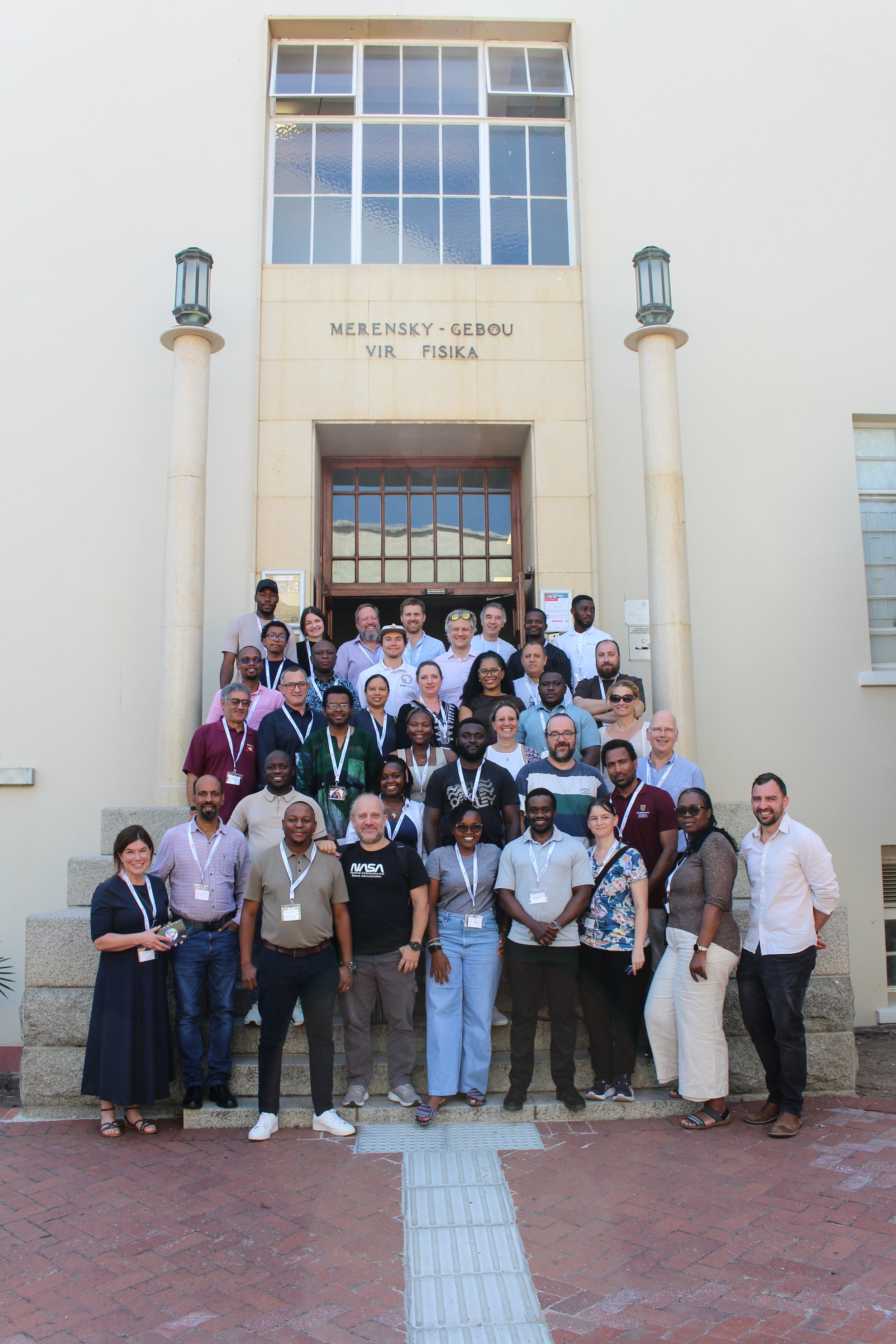
FDL Foundations Big Think, NITheCS, Stellenbosch, South Africa 2026
