Towards a ‘Mission Control for Earth’: Better understanding Earth’s systems using AI and space data
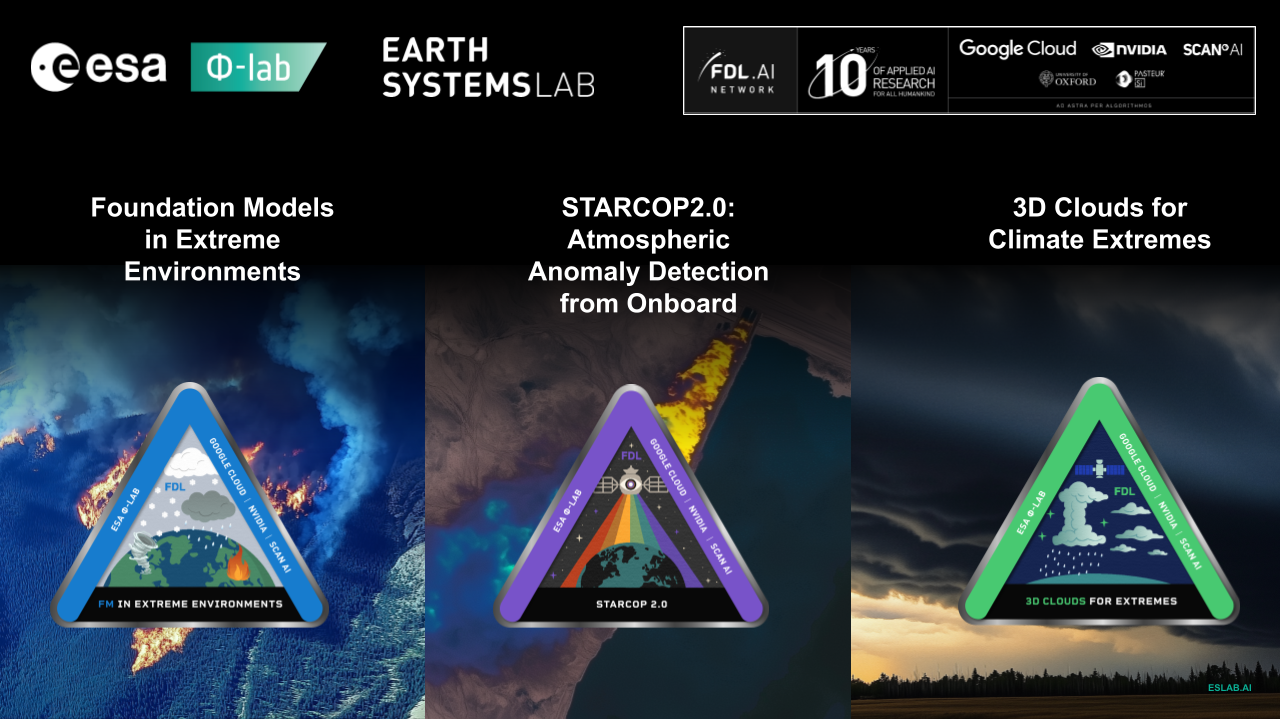
In August 2025, FDL Earth Systems Lab presented three big AI research outcomes to improve how we understand and predict Earth’s changing systems and offer a window on how we might build a ‘Mission Control for Earth’. Leveraging the European Space Agency’s missions and funded by ESA Φ-lab, this initiative combines fresh datasets with innovative AI tools to give the global community better ways to track and respond to our planet’s most urgent environmental shifts.
“Guided by artificial intelligence, driven by human good”. This could be FDL Earth Systems Lab (ESL)’s motto. ESL is a research collaboration framework funded by ESA Φ-lab and implemented by Trillium Technologies, with the support of University of Oxford, Google Cloud, NVIDIA, Scan AI, and Pasteur ISI. It focuses on artificial intelligence (AI) – in particular machine learning (ML) – to support Earth sciences, helping researchers create practical tools for some of humanity’s toughest challenges with the best of motivations: ‘planetary stewardship’.
FDL Earth Systems Lab has run annually since 2008. Experts with deep knowledge of the challenge domain work side by side with data scientists to develop new AI-enhanced approaches and tools. The short, focused format encourages quick testing and refinement, ensuring stronger results.
Last August, the ESL 2025 Live Showcase featured three ambitious research sprints: (1) refining 3D cloud models to improve forecasts of extreme events; (2) testing how well foundation models perform in sparsely observed events; and (3) advancing onboard ML to spot short-lived atmospheric events, such as greenhouse gas emissions. Each sprint brought together unique datasets and new AI-based methods to support the global research community.